These notes describe playtest 0.10. Read the new 0.11 Combat Stance update. The direct rules links below open the current rulebook.
Laser Squad 0.10 is a substantial playtest revision of the free Gollops Star board game. Hit rolls are quicker, each soldier completes their activation before the next begins, medkits can be reused, and the first mission now has a much larger encounter deck and a final surge of enemies.
This is still a pre-release test kit. The revised rules and printable components are available now in illustrated and low-ink formats.
What returning players need to know
| Rule | Before | Version 0.10 |
|---|---|---|
| Hit rolls | 6s to hit, with extra Blind Luck confirmations at low accuracy. | At accuracy 1+, any 5 or 6 hits. At 0 or less, roll one D6 and hit on a 6. No luck dice. |
| Disengage | 4 AP with a restricted escape move. | 2 AP ends engagement without moving. A separate Move costs 2 AP. |
| Armour changes | Equipment organised through the older slots-based rules. | Equipping or changing worn armour explicitly costs 4 AP; changing weapons costs 1 AP. |
| Machine Gun penetration | Reduced cover, affecting hit chance. | Reduces armour by 1, to a minimum of zero, when resolving damage. |
| Medkits | Discarded after use. | Reusable, at 2 AP per use. Park starts with one kit. |
| Carried gear | Hand, sidearm, belt and other slot limits. | No item-count limit. Keep one weapon, one armour and one shoulder mount active; carried weight penalties still matter. |
Finish one soldier. Then pass command.
The squad leader’s controller takes the first player turn, then play passes clockwise. Reyes is identified as the squad leader on his card. Each player completes every soldier they control, one activation at a time, in any order they choose. Actions no longer interleave between soldiers.
Unspent AP are lost when a soldier’s activation ends. They cannot return later in that phase, transfer AP or save them for another round. Units refresh to their own allowance; the current Laser Squad uses 4 AP unless a card or mission says otherwise. A revived soldier acts next round. In solo play, complete all five in any order, one at a time.
The leader’s controller remains first if the leader is downed or evacuated. Players without eligible soldiers simply pass.
Faster attacks, clearer Friendly Fire
At modified accuracy 1 or more, roll that many D6 for each shot: one or more 5s or 6s produce one hit. At accuracy 0 or below, roll a single D6 and hit only on a 6. Luck dice and Blind Luck confirmations have been removed.
Ranged attacks combine unit Accuracy, weapon Accuracy and relevant modifiers. Close combat instead combines Strength and eligible active weapon Accuracy, minus melee defence; do not add the unit’s ranged Accuracy.
After any permitted rerolls, a single-target ranged shot can cause Friendly Fire if its final roll contains at least one 1 and no 5 or 6. Select a conscious ally on the intended enemy’s tile: nearest to the enemy’s actual space by orthogonal distance, then lower cover from the shooter, then randomly.
Remove one die per point of that ally’s own cover, removing 1s first. If a 1 remains, the ally is hit once; otherwise the shot misses them. Do not roll again. Apply normal damage, armour and penetration. The shooter, downed units and aliens waiting inside vents are not eligible victims, and Friendly Fire never chains. Ordinary close combat does not use this rule; alien ranged fire can endanger its own allies.
At accuracy 0 or less, a 5 misses the enemy but cannot trigger Friendly Fire. Armour reducing damage to zero still leaves a hit, rather than a miss. Resolve all printed shots against the original enemy’s last position even if it dies; later shots can still threaten allies, and cannot be redirected to another enemy.
Area-effect rules are also clarified: target a visible tile in range using the card’s instructions. Cover is ignored. Roll attack power once for each successful area hit and apply that result to every unit on the tile, including friendlies and vent reserves; each subtracts its own armour. This is not a random Friendly Fire victim roll. These are general rules, not an announcement of additional weapon cards.
Quick combat reference, clarified
The corrected reference tables use simple base formulas: melee dice = Strength + active weapon ACC; ranged dice = unit ACC + weapon ACC − cover, with corner shelter counted as cover. Existing card and state effects—including Brace, WOTE, Precision and Laser Scope—still apply. There is no inherent alien Defence stat; Brace defence remains a state effect.
On a missed ranged shot, count the rolled 1s and subtract the eligible friendly victim’s cover: one or more remaining 1s cause one hit, subject to the normal Friendly Fire trigger and damage rules above. Use equipment or monster cards for damage; unarmed damage is D6−2 before normal armour.
Loadouts, healing and squad balance
- Every soldier starts with a Combat Knife. The separate starting deck contains 16 dealt items, plus a spare Exo-Plate that is not assigned to a starting loadout.
- Machine Gun: Accuracy +0; Penetration reduces armour by 1 during damage, including Friendly Fire. It does not reduce cover.
- Voss: Accuracy +1. Heavy Weapons Specialist ignores all Speed penalties from his worn armour and active weapon. Other carried, inactive armour and weapons still impose their penalties; his base Speed remains 3.
- Okafor: Accuracy +1. Precision adds +1 Accuracy with a sniper rifle, including Overwatch, replacing the old sniper damage reroll. Sniper Rifle damage is D6+2.
- Park: Field Medic, with one reusable starting medkit. Her medkit heals 5 HP or revives to 3 HP. A normal medkit heals 3 HP or revives an adjacent soldier to 2 HP, for 2 AP per use; keep the kit. Normal range, maximum HP and engagement restrictions apply.
- Chen: Close Assault remains a shotgun attack-die reroll during her own activation; its wording no longer refers to luck dice.
Combat Plate is now Sentinel Armour: Medium armour, damage reduction 2 and Speed penalty 1. Voss wears it at setup. The others start in Pathfinder Armour: Light, reduction 1 and no Speed penalty. Exo-Plate remains Heavy, with reduction 3 and Speed penalty 2.
Carry freely. Choose what is active.
Carry any number of items, with one weapon, one armour and one shoulder mount active at once. Keep active cards upright and inactive gear upside down. Only the active weapon attacks, worn armour protects and installed shoulder equipment functions. Handheld equipment such as a medkit does not require another active category.
All carried armour and Heavy-weapon Speed penalties accumulate, including inactive gear and duplicates. Speed cannot fall below zero. Heavy Weapons Specialist makes only the equipped exceptions described above.
Swapping active weapons costs 1 AP; equipping or replacing armour costs 4 AP. Shoulder installation, removal or swapping costs 1 AP. The new Laser Scope adds +1 Accuracy to its own ranged weapon, including Overwatch and legal close-combat use. Install, uninstall or transfer it between your own weapons for 1 AP, with one scope per weapon.
Trade is now a 1-AP action by one initiating soldier. Both soldiers must be conscious, unengaged and on the same tile. Exchange any number of items, with at least one changing owner; the recipient pays no AP. Both may choose a carried weapon as active for free. This does not grant free armour or attachment installation.
Uninstall scopes and shoulder gear before trading them, and uninstall a scope before trading its weapon. The recipient pays normal installation costs. Trading worn armour removes its protection. Trade cancels both soldiers’ Overwatch, but not Brace, because neither moved. A recipient whose activation has ended gains no fresh activation or AP.
Contact, escape and alien movement
Free contact swaps and free Brace reactions have been removed. Existing Overwatch is the only interrupting player response to an alien action: it may fire before first-contact engagement applies, and ends at contact whether its owner fires or declines.
While engaged, attack an engaging enemy, swap active weapons or Disengage. Equipment can be used only if its card explicitly permits use while engaged. Legal active melee choices remain melee weapons, one-handed weapons and shotguns; otherwise fight unarmed.
The 2-AP Disengage ends current engagements without moving. Old adjacent contacts are ignored for the remainder of that activation unless the unit attacks in contact or deliberately enters new contact. A new enemy engages normally; any contacts still present reapply when the activation ends. Movement stays orthogonal. Diagonal combat contact needs both intervening orthogonal spaces and their connecting edges open.
Alien Swarm lets aliens pass through other aliens, including engaged ones, but they must land in an empty space and check new contact at the next empty space. An engaged alien still needs Disengage before leaving combat. Soldiers cannot pass through engaged friendly soldiers.
Tile placement and vent reserves
Test all clockwise quarter-turn orientations when placing a tile. Connect the entry, prefer matching every touching edge, then maximise usable onward exits; ties use the fewest clockwise turns from the revealed face. If no orientation matches all neighbours, maximise existing exit connections first, then onward exits, then use the same tie-break. Seal unmatched and off-table edges on both sides. Settled tiles do not rotate.
Aliens that cannot fit on a vent tile wait inside that vent. Each reserve tries to emerge into a free space when its own activation comes; earlier aliens may have made room. If no space is free, it takes no actions. Reserves cannot be directly shot or selected by single-target Friendly Fire, but area effects reach them and they count when checking whether a tile is clear. Without a vent, discard excess aliens: no off-tile spawn, queue or extra ambush.
A new chapter: Mission 1 — Distress Signal
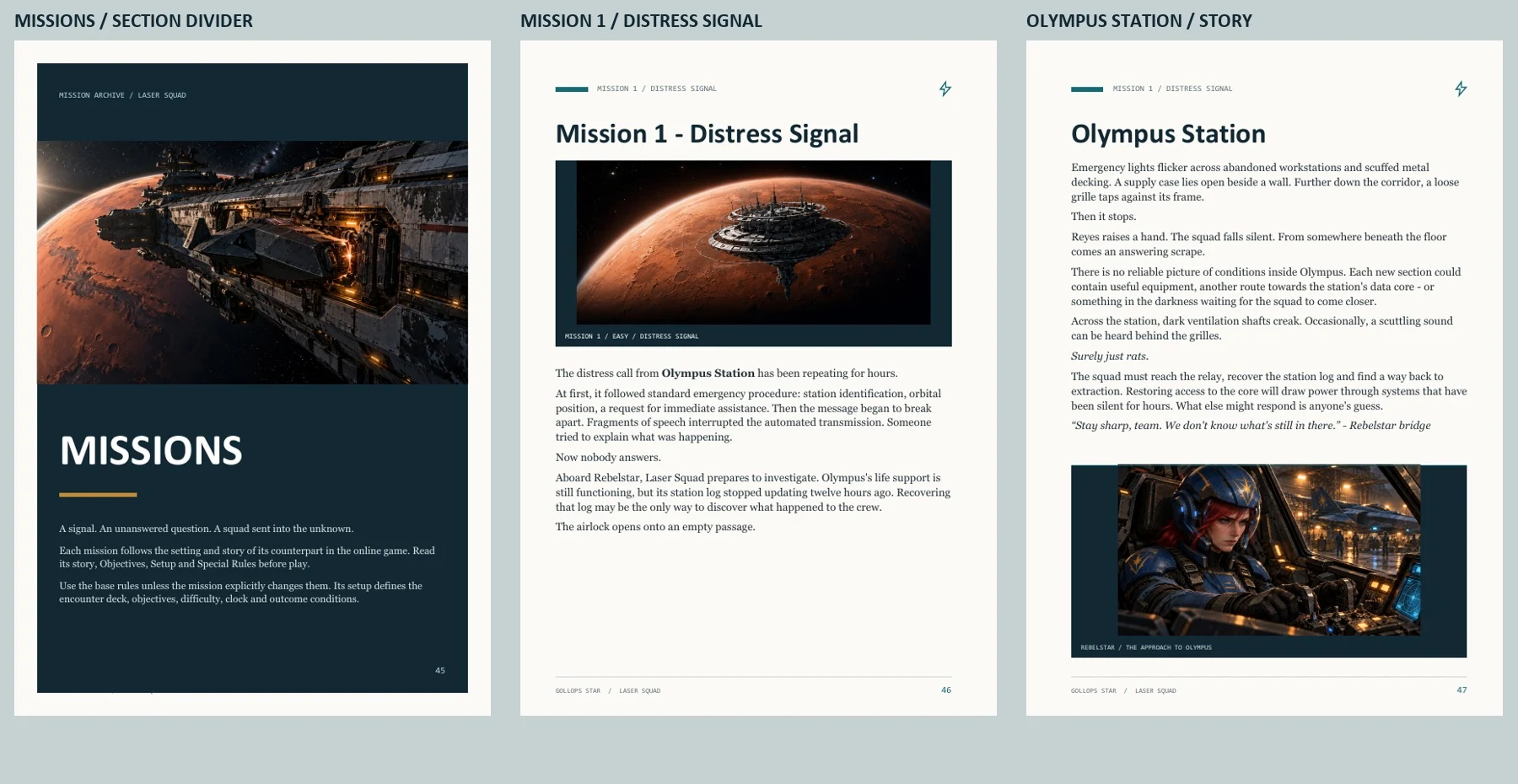
The illustrated manual now has a dedicated Missions divider, followed by the opening story on Olympus Station. The name and setting match the online game: Distress Signal replaces the earlier board-game working title, Distress Relay.
The story preserves the mystery of that first arrival, before the squad knows what is waiting in the darkness. The chapter then separates Objectives, Setup and Special Rules, making it easier to prepare the station and find a rule during play. Recovering the station log remains the objective; the relay/core download, encounter deck and extraction mechanics are unchanged. This kit includes Mission 1 only.
Distress Signal: an easy mission with a hard exit
General rules now sit separately from mission setup, deck composition, objectives, difficulty, clock and outcomes. Mission instructions take priority. Distress Signal is the first mission, rated Easy, starting with 20 rounds; events can change the remaining time.
Set the airlock aside, randomise tile quarter-turns and insert extraction anywhere in the ordinary tile stack, including among starting neighbours. For this mission, reserve the first 15 prepared draws, shuffle the objective into the rest and place those 15 back on top. Starting neighbours, extraction and rejected draws count; the airlock does not. The objective is the sixteenth draw or later, not necessarily the sixteenth placement. Reveal tiles sideways like turning a book page.
Clear the objective tile, including vent reserves, then spend 2 AP at its centre to activate the relay and download the core, recovering the station log. If Lost Transmission was drawn before activation, complete its recorder/airlock task first. It remains an ordinary shuffled encounter, without guaranteed discovery.
Final Wave: pause after activation and draw a fresh encounter for every discovered vent, including an objective-tile vent. Discard old hidden encounters there unresolved. Process vents nearest the objective by connected tile distance, ties north then west. Spawn only monster draws; discard other fresh cards without effects. Existing aliens remain, the new aliens act in the coming alien phase, and the downloaded core stays complete.
Finish the Final Wave before evacuating soldiers already on extraction. After the download, conscious soldiers on extraction can leave for no AP and cannot return. Evacuate all five for an immediate full win. At the deadline, a complete objective with one to four evacuated is a partial win; no evacuees or an incomplete objective is a loss. Score early if everyone still aboard is downed. Downed soldiers must be revived to evacuate normally. The clock continues after activation.
The complete 57-card Distress Signal deck
Print all six category front sheets once and shuffle the cards together into one encounter deck. The categories organise printing, not separate gameplay decks.
| Aliens on a card | Worker copies | Warrior copies | Razorhound copies |
|---|---|---|---|
| 1 | 4 | 4 | 2 |
| 2 | 3 | 3 | 3 |
| 3 | 2 | 2 | 2 |
| 4 | 1 | 1 | 1 |
Across the deck, these groups can spawn 20 Workers, 20 Warriors and 18 Razorhounds.
11 items
Shoulder Torch ×1; Shoulder Scanner ×1; Medkit ×2; Pistol ×1; Shock Baton ×2; Laser Scope ×2; Sentinel Armour ×1; Exo-Plate ×1. No encounter knives: everyone now starts with one.
10 events and tasks
Weapon Jam ×2. One each of Dust in the Contacts, Reserve Oxygen, Orbital Decay, Two Keys — Key A, Two Keys — Key B, Gravity Stabiliser, Hold the Relay and Lost Transmission. Gravity Stabiliser replaces Isolated Sensor. Both keys remain separately shuffled, with their discovery rule unchanged.
8 No Event cards
Empty Watch, Old Footsteps, Cooling Metal, Dead Channel, Abandoned Shift, False Contact, Quiet Machinery and After the Alarm.
Print the encounter-back sheet four times and use 57 of its 64 backs. Do not also print the combined encounter fronts.
A clearer, more illustrated manual
The illustrated rules now run to 60 A5 pages; the low-ink book is 28 A4 pages. Both are standalone, phone-readable PDFs. Setup, turn order, movement, combat, equipment, skills, aliens and missions have distinct sections, with updated examples, linked contents, glossary and index. The separate four-page setup guide keeps printing instructions out of the rules.
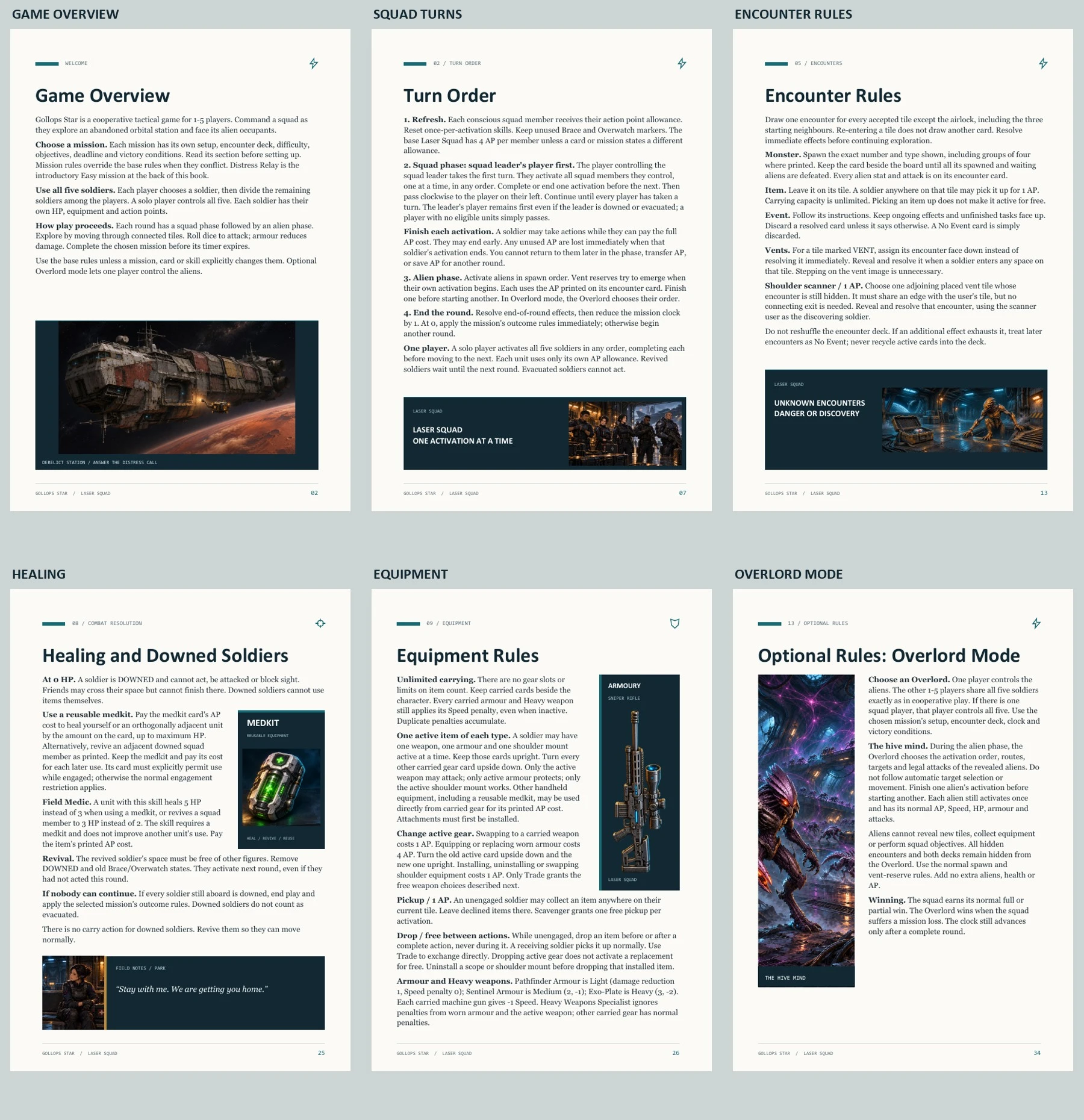
The illustrated manual adds portrait quotes, a medkit feature, an upright rifle cutout, highlighted rules, a cinematic mission opener and tall Overlord artwork. It includes the newly approved vent-discovery scene and 25 unique footer illustrations. These presentation changes support the rules; they are not extra gameplay mechanics.
Clearer low-ink monster cards
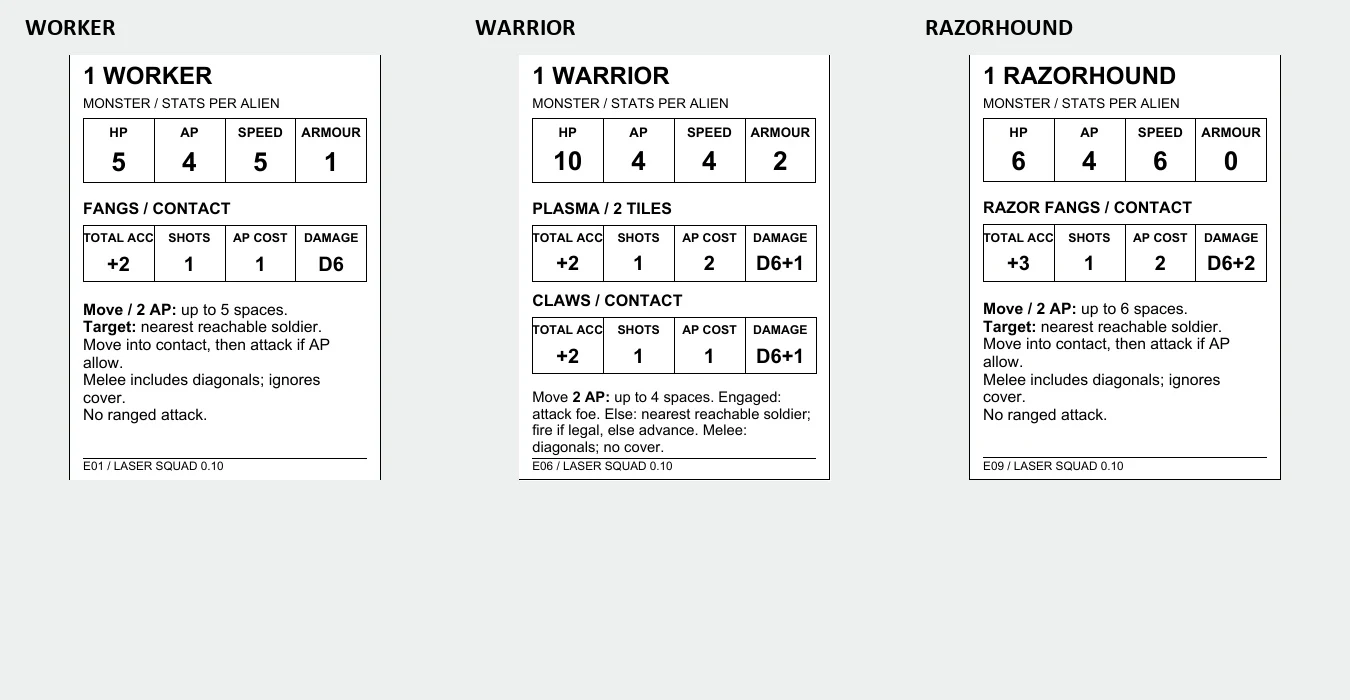
All 28 print-friendly monster cards now have large HP, AP, Speed and Armour grids, with separate attack blocks and aligned Total ACC, Shots, AP cost and Damage values. Warriors show Plasma and Claws separately. Small behaviour notes remain; low-ink flavour text is omitted to prioritise legibility. Stats, spawn counts, mechanics, card size and backs are unchanged.
Your reprint checklist
- Replace the rulebook and player references, then use the updated setup guide.
- Replace character cards, especially Reyes’s leader label and the revised Voss, Okafor and Park details.
- Print the two starting-equipment face pages once: all five knives, 16 assigned items and the spare Exo-Plate. Print starting backs twice and use 17.
- Rebuild the 57-card mission deck from all six current front sheets: extra monster groups, two Laser Scopes, two Shock Batons, Sentinel Armour, Exo-Plate, the second Weapon Jam and renamed Gravity Stabiliser.
- Use the updated token and standee sheets for the larger figure allocation and IN VENT markers. The optional standees cover 63 figures on six A4 pages.
- Existing unchanged tile artwork and matching backs can be reused; you do not need to reprint them solely for a new illustration.
The optional miniature downloads remain prototype 0.1. They predate the new starting-knife and Park loadout changes; the current cards govern play. Supports and physical test prints are still required. Miniatures remain optional alternatives to tokens and standees.
Some familiar rules have also been clarified rather than newly added: straight legal firing lanes and tile-counted range, Brace’s existing +1 ranged accuracy/+1 melee defence, faulty gear retaining its fault when inactive or traded, and action costs taken from the relevant card.
© 2026 Myke Black. Free board-game downloads are for personal, non-commercial use only. No resale or commercial reuse. Full download licence.