Okafor can see through the doorway. Move him back down the corridor, and the wall beside that same door might hide his target. Position matters—and the new sight rules make that position easier to judge.
Gollops Star: the board game 0.19 uses one line-of-sight rule in every mission, whether the squad is inside Olympus Station or out on the Martian surface. The Tabletop Simulator version also gains painted 3D figures for all five soldiers and every alien type, with names on their bases.
- Space-to-space sight checks, including angled shots through station doors.
- One range-counting method for indoor and outdoor missions.
- Six illustrated sight examples in the Rulebook.
- Named painted 3D figures, updated books and player-facing counters in Tabletop Simulator.
Draw the line from soldier to target
Lay a straight edge from the centre of the shooter’s space to the centre of the target’s space. A shot is possible if that line is clear and the target is within the weapon’s range.
Walls, rock spaces, sealed exits, locked doors, gaps in the board and face-down tiles block sight. Smoke blocks shots into or through its tile, but a figure standing inside the smoke can shoot out. Figures and cliff edges do not block sight.
Station shots can now run at any angle. Being on the same tile as an alien is not enough by itself: a wall drawn between the two spaces can still block the shot.
Doorways, corners and craters
A doorway gives a soldier a view into the room beyond. Further down the corridor, the walls narrow that view. A target tucked into a room’s near corner may be hidden even when another alien in the middle of the room is visible.
A line that only touches the end of a wall or the corner of a rock space is clear. If wall or rock lies on both sides of the line at that point, it is blocked—you cannot squeeze a shot diagonally between two touching obstacles.
On the surface, a crater’s rim counts as a wall for shooting, with an opening in the middle of each edge. Shoot through a gap, not through the rim. The rim still does not slow movement. Other rocks and enclosed structures use the same blocking rules as station walls.
The Rulebook’s six illustrated examples cover doorways, room corners, touching rocks and crater rims. Open section 8.1 when a close call comes up at the table.
Count range in tiles
Range still uses tiles rather than individual spaces. Count how many tiles across and how many up or down the target is; use the larger number. A diagonally touching tile is 1 tile away. A target two tiles across and one up is 2 tiles away. A target on the shooter’s own tile is at range 0.
Grenades follow the same sight check: choose a tile with at least one space the thrower can see, up to 2 tiles away. You do not need to see every space on that tile.
Most shots are obvious. Reach for the straight edge when the angle is close.
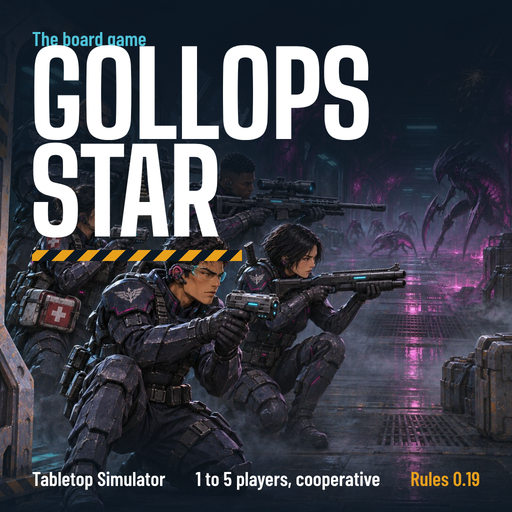
Painted forces on the virtual table
The Tabletop Simulator update replaces the flat round figure tokens with painted 3D models: Reyes, Chen, Calder, Okafor and Park, alongside Thralls, Warriors, Razorhounds and the Elite. Each design has its name curved around its base.
The HP counters and mission clock face the players. The table includes the updated Rulebook, Mission Book and Quick reference, plus a sight-rule tip in Notebook → How to play.
The existing one-button setups for Distress Signal, Lab Recon and Comms Relay remain, alongside skill cards, the Campaign Mode switch, status markers and dice. The table supplies the pieces; players resolve the rules as they would at a physical table.
Load the updated save
Already have Tabletop Simulator? Download the current 0.19 save and put it in Documents\My Games\Tabletop Simulator\Saves, then load it through Games → Save & Load. The save loads its assets from the website.
The hosted save is free. Tabletop Simulator itself is a separate game on Steam and is required to use it.
Keep the set together
The print-friendly and illustrated editions both have the updated books and references. The DNA Sample card’s cross-reference now points to Campaign Mode. The base set still has 71 tiles, 119 encounter cards, 18 skill cards and 16 starting items.
Use the download page for the complete print-friendly kit or the individual illustrated PDFs. Open the current Rulebook and Mission Book directly on a phone while playing.