The creator of Gollops Star talks about the games that inspired it, the practical challenges of building it and the hope that players will simply have a great time. Answers have been lightly edited for clarity.
QUESTION 01
What inspired Gollops Star?
Julian Gollop was my childhood game-development hero. The original X-COM games—UFO: Enemy Unknown and Terror from the Deep—were a huge inspiration. I wanted to build a game that pays homage to them, with elements of other tactical games such as Laser Squad and Rebelstar. Even the melee combat draws on the idea of being engaged in combat from Chaos: The Battle of Wizards.
I wanted to see whether it was possible to build a good turn-based tactical game that could run in a browser. The first version was built in pure JavaScript, without Three.js, which the new version uses.
QUESTION 02
How did you turn all those ideas into something playable?
The hardest part about getting started was having so many ideas. It was difficult to pin them down to a simple, playable demo.
I created a prototype using static images on a basic map and tested different ways to move the pieces around. It wasn’t until I could shoot and kill the first alien that it started to feel as though some fun was being distilled into the game.
QUESTION 03
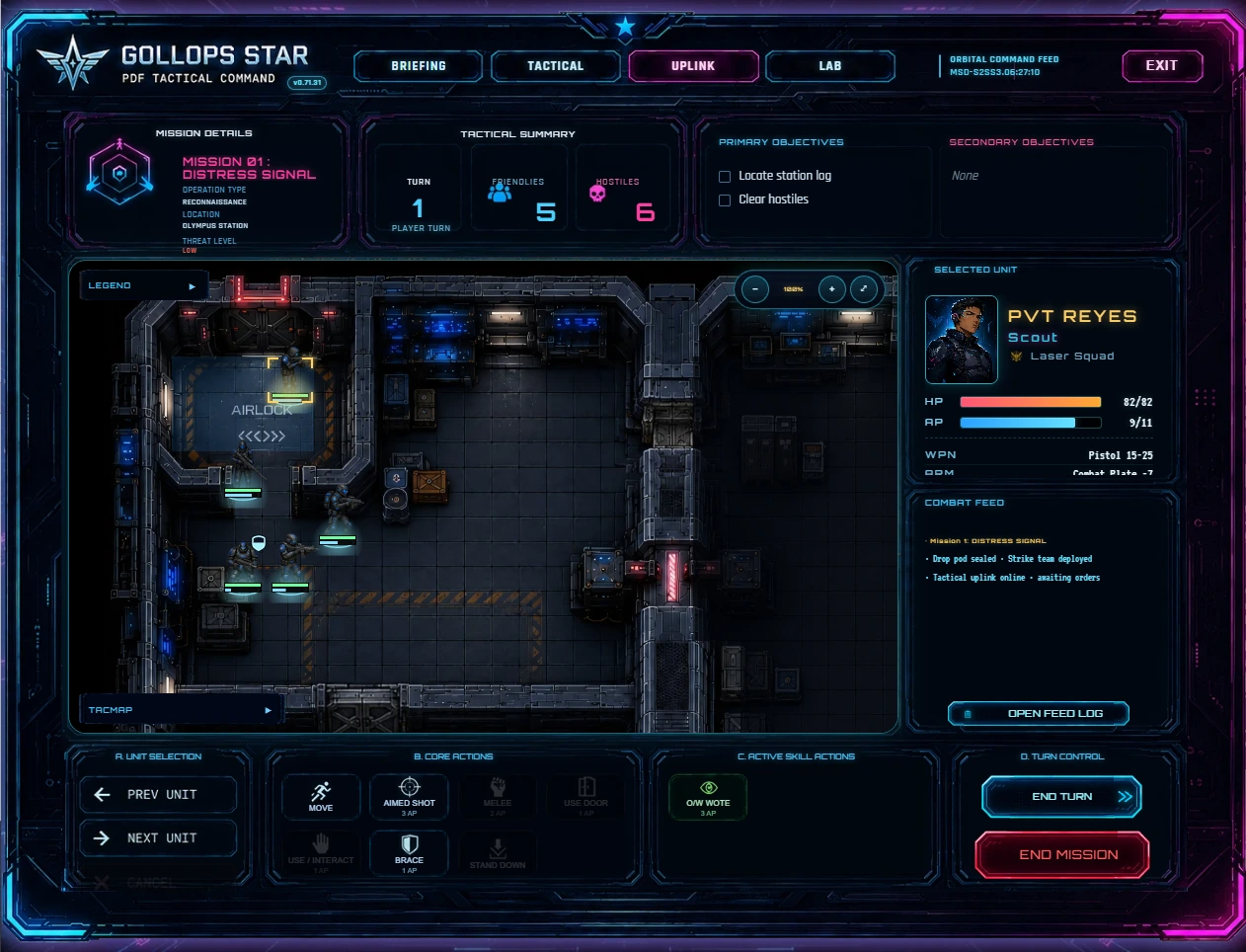
Why move from 2D to 3D?
My original idea was to use sprites, like old-school games, with animations for walking, turning and melee combat. That quickly became cumbersome because the number of sprites grows with every unit, alien and type of movement you introduce.
An isometric sprite needs four—or better yet, eight—directional facings. A top-down game can get away with rotating a single sprite, but an isometric game can’t. Then, for every direction, you need images for walking, shooting, ducking behind cover and so on.
For what I wanted to achieve, 3D models became the practical answer. I took the 2D version as far as I could, but to really make it feel alive, I needed to go 3D.
QUESTION 04
What was the hardest part of making that move?
Creating the models. I’m not an artist, and I’m not skilled in 3D modelling. This is where AI really helped.
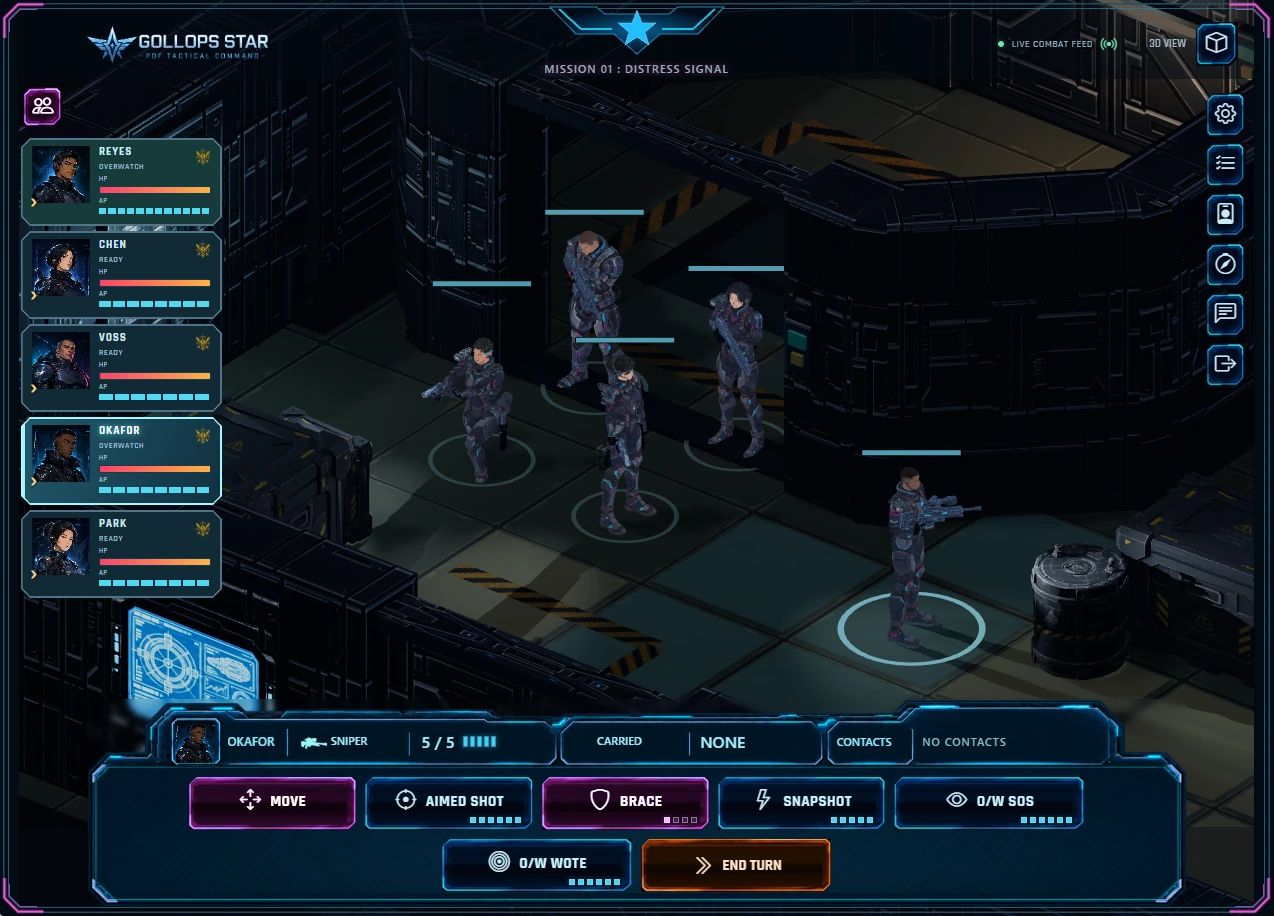
I used Meshy to create the game’s 3D models and rig the skeletons of the soldiers and other units. I made reference-image designs in ChatGPT and, almost by accident, ended up with a model that had a cool painted, cartoon-like style.
I decided to go with it and give the whole game an anime-inspired, painted look. Rather than relying on highly detailed geometry, the walls and models could use fewer polygons and let the stylised textures do more of the work.
QUESTION 05
What makes it your own game?
I’m a big turn-based strategy fan. Two of my favourites are XCOM 2 and Phoenix Point. Every game I play has features and moments that I find really fun.
I wanted to bring those moments together: the impossible snapshot from a laser cannon in Laser Squad that somehow hits and takes the target down; the carefully planned overwatch in the original Space Hulk; or the ambushes in Phoenix Point where something suddenly takes out half your squad.
I haven’t set out to invent something completely new. There are a few small ideas of my own, but mostly I’ve brought together my favourite parts of the games I love. I hope people playing it find the same fun that I did.
QUESTION 06
How did the board-game version enter the picture?
I spend a lot of time playing board games too. I love cooperative games with friends because there’s so much fun in working together towards a common goal.
While designing the first 2D version, I imagined it wouldn’t be too different from playing on a big cardboard map on a tabletop. That’s where the idea came from. It was only after completing the 2D game that I had enough brain juice left to start thinking about designing the board game.
QUESTION 07
What should carry over to the tabletop—and what needs to change?
I want to preserve the story and the dark atmosphere. Each character has a backstory, some have secrets yet to be uncovered, and there are parts of the story that the online game doesn’t tell. I’d like the board game to tell that same story from a different point in time.
The biggest difference is the mechanics. How does movement work? How do you decide whether a shot hits, and how much damage it does? How do you create a sense of progression within a two-hour board game? Those are all questions that still need to be figured out.
QUESTION 08
Why make the base game free?
I want it to reach as many people as possible and to keep it as an open-source project. The online game is free to play and will remain so indefinitely.
I want to offer the base board game for free as a digital download. If there’s enough interest, I might be able to produce a physical version to sell at close to cost. If that goes well, I have plans for expansions that would likely be physical copies only.
QUESTION 09
What are you focusing on next?
Finishing the online game and playtesting the board game. I also need to set up a proper feedback loop, which I haven’t got around to yet.
Once that’s in place, I’d like the community to help steer the project with ideas and feedback.
QUESTION 10
What would you say to someone discovering the game for the first time?
Keep an open mind—it isn’t finished yet. The first squad and the first two missions are built and playable, so have fun with those. You can now subscribe for updates on the website.
If you’d like to help with development costs or send a little appreciation, you can buy me a coffee on Ko-fi. Or simply share a link to the game on your social media.
My hope is that people play, lose themselves for a few hours, and afterwards think, “Well, that was really fun.” That’s about the best outcome any game designer could want.